



Machine studying datasets usually include dozens, lots of, and even 1000’s of options.
Although these options can present helpful info, they will additionally introduce redundant variables, enhance computational prices, and make patterns tougher to determine. Working with all obtainable options doesn’t at all times produce higher outcomes.
Dimensionality discount addresses this problem by representing knowledge with fewer dimensions whereas preserving info related to the duty.
Depending on the strategy, this could contain figuring out a smaller set of options, combining current options into new representations, or mapping complicated knowledge right into a lower-dimensional house.
Understanding how these strategies work helps knowledge scientists simplify datasets, visualize complicated relationships, and construct extra environment friendly machine studying pipelines.
What Is Dimensionality Reduction in Machine Learning?
Dimensionality discount is the method of decreasing the variety of options or dimensions used to characterize a dataset whereas retaining as a lot related info as potential.
In machine studying, a dimension normally corresponds to a characteristic or variable. For instance, a buyer dataset would possibly include age, revenue, buy frequency, common order worth, shopping exercise, and lots of of extra behavioral attributes.
Each attribute contributes one other dimension to the characteristic house.
Consider a dataset containing 100 options. Some would possibly measure comparable behaviors, whereas others might contribute little to the prediction process.
A dimensionality discount technique would possibly remodel these options into 15 elements that retain a lot of the dataset’s essential variation.
The goal isn’t merely to take away info. It is to discover a extra compact illustration that makes the info simpler to course of, analyze, or mannequin.
For instance, a picture dataset might include 1000’s of pixel values per picture. Reducing its illustration can assist reveal patterns in the info or make downstream computations extra manageable.
However, fewer dimensions don’t routinely imply a greater mannequin. A discount technique can discard info that issues for prediction. The ensuing illustration should subsequently be evaluated towards the supposed process.
Why Is Dimensionality Reduction Important?
Reducing the variety of options can enhance the effectivity and interpretability of machine studying workflows. Its advantages rely on the unique dataset, the chosen method, and the mannequin being educated.
1. Reduce computational complexity
Many machine studying operations grow to be dearer because the variety of options will increase. A smaller characteristic house can scale back reminiscence necessities and pace up operations equivalent to distance calculations, mannequin coaching, and sure types of clustering.
This is especially helpful when working with giant datasets or high-dimensional knowledge equivalent to textual content embeddings and picture representations.
2. Address the curse of dimensionality
As the variety of dimensions will increase, knowledge factors can grow to be sparse relative to the scale of the characteristic house. This could make neighborhood relationships and distance-based strategies much less efficient with out ample knowledge.
Dimensionality discount can assist by producing a extra compact illustration, though it doesn’t get rid of each problem related to high-dimensional knowledge.
3. Reduce redundant info
Datasets usually include correlated options. For instance, a buyer’s month-to-month spending and annual spending might characterize carefully associated info.
Methods equivalent to Principal Component Analysis (PCA) can mix correlated variables right into a smaller set of elements. This might scale back redundancy with out requiring the analyst to decide on particular person variables manually.
4. Improve knowledge visualization
High-dimensional datasets are tough to examine immediately. Techniques equivalent to t-SNE and Uniform Manifold Approximation and Projection (UMAP) can map knowledge into two or three dimensions, making native patterns and potential clusters simpler to discover.
These visualizations are helpful for exploratory evaluation, however obvious separation in a plot doesn’t essentially set up that the identical teams are separable in the unique characteristic house.
5. Simplify downstream modeling
Some algorithms are delicate to redundant options, noise, or the geometry of the characteristic house. A rigorously chosen discount method might enhance mannequin efficiency or make coaching extra environment friendly.
However, the impact is model-dependent. Tree-based fashions, for instance, might not profit from PCA in the identical manner as some linear or distance-based fashions. Performance ought to be measured quite than assumed.
How Does Dimensionality Reduction Work?
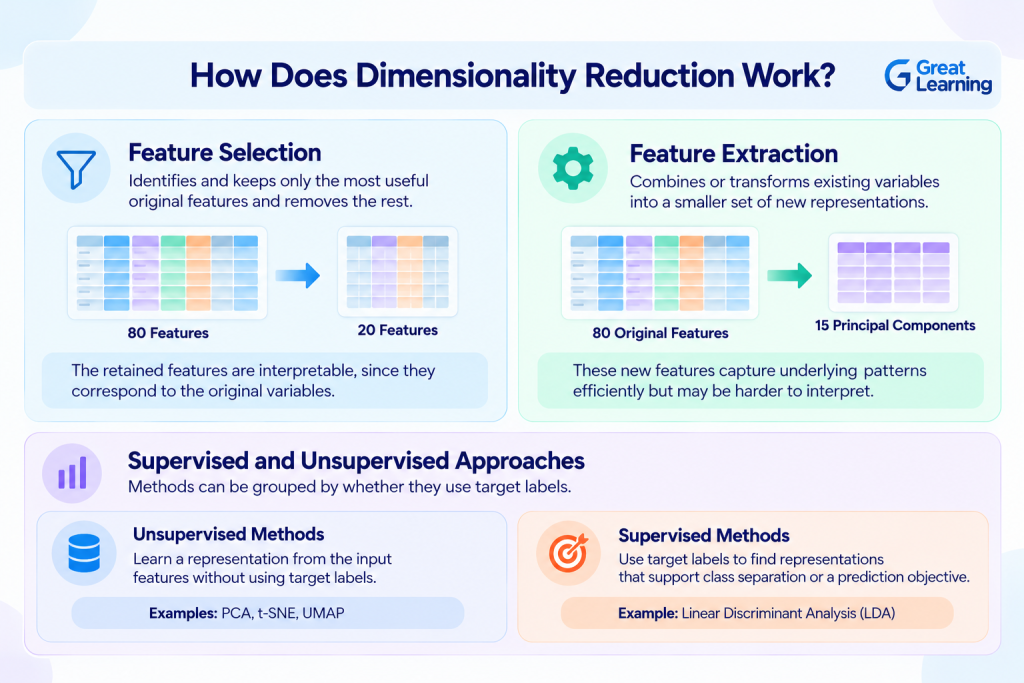
Dimensionality discount typically follows two approaches: characteristic choice and characteristic extraction.
Feature choice retains a subset of the unique variables. Feature extraction transforms the present variables right into a smaller set of representations.
Feature choice
Feature choice identifies the unique options which might be most helpful for a specific process and removes others.
Suppose a buyer dataset incorporates 80 options, together with age, revenue, buy frequency, buyer tenure, and several other overlapping engagement metrics. A range technique would possibly retain 20 helpful options.
The retained options stay interpretable as a result of they correspond to the unique variables. Methods equivalent to filter-based characteristic choice, regularization, and model-based significance measures can assist this course of.
Feature extraction combines or transforms current variables to supply a lower-dimensional illustration.
For instance, PCA can convert 80 unique options into 15 principal elements. These elements are mixtures of the unique variables quite than chosen columns from the preliminary dataset.
This strategy can seize underlying patterns effectively, however the ensuing elements could also be tougher to interpret individually.
For hands-on apply with preprocessing, characteristic engineering, and mannequin analysis, discover Python for Data Science and Machine Learning course from Great Learning Academy.
Master Python for ML & Data Science
Learn Python for knowledge science and machine studying to unlock limitless alternatives. Its ease of use and highly effective libraries assist you remodel knowledge into insights & construct clever programs seamlessly.
Enroll Now
Supervised and unsupervised approaches
Dimensionality discount strategies may also be grouped by whether or not they use goal labels.
- Unsupervised strategies: Learn a illustration from the enter options with out utilizing goal labels. PCA, t-SNE, and customary UMAP are widespread examples.
- Supervised strategies: Use goal labels to search out representations that assist class separation or one other outlined prediction goal. Linear Discriminant Analysis (LDA) is one instance.
The selection depends upon the duty. For exploratory visualization, an unsupervised technique could also be applicable. For a classification downside the place class separation issues, a supervised technique could also be extra appropriate.
Which Dimensionality Reduction Techniques Should You Know?
Different algorithms protect completely different properties of the unique knowledge. Some concentrate on total variation, whereas others emphasize native neighborhoods or class separation.
| Technique | How it really works | Best suited to | Main limitation |
| Principal Component Analysis (PCA) | Projects knowledge onto instructions that seize the best variance | General-purpose linear discount and preprocessing | Components could also be tough to interpret |
| Truncated Singular Value Decomposition (SVD) | Factorizes a matrix right into a smaller illustration | Sparse, high-dimensional knowledge, together with textual content options | The diminished illustration might lose helpful info |
| Linear Discriminant Analysis (LDA) | Finds projections that separate labeled lessons | Supervised classification and visualization | Requires class labels and has a restricted variety of elements |
| t-distributed Stochastic Neighbor Embedding (t-SNE) | Maps comparable factors right into a lower-dimensional house, emphasizing native neighborhoods | Exploring high-dimensional knowledge visually | Global distances and cluster sizes will be deceptive |
| Uniform Manifold Approximation and Projection (UMAP) | Learns a lower-dimensional illustration that approximates neighborhood construction | Visualization and sure nonlinear discount duties | Results rely on parameters and will distort some relationships |
| Autoencoders | Use a neural community’s compressed illustration to reconstruct its enter | Complex, nonlinear knowledge equivalent to photos or realized embeddings | Require coaching and cautious structure choice |
1. Principal Component Analysis (PCA)
Principal Component Analysis is without doubt one of the most generally used dimensionality discount methods. It identifies instructions in the info that seize the best variance and tasks the unique options onto these instructions.
For instance, a dataset with 50 numerical options is perhaps remodeled into 10 principal elements that protect 95% of the coaching knowledge’s variance.
The 95% determine is an illustrative goal, not a assure that 95% of predictive info has been retained. Explained variance measures variation in the options, not their direct usefulness for predicting a goal.
Because PCA is delicate to characteristic scale, standardizing numerical options is commonly applicable when their items or ranges differ considerably.
See the scikit-learn documentation on unsupervised dimensionality discount for implementation particulars.
2. t-SNE and UMAP
t-SNE and UMAP are particularly helpful for exploring high-dimensional knowledge visually. They can reveal native groupings and neighborhood buildings which might be tough to examine in the unique characteristic house.
However, their visible outputs require cautious interpretation. In t-SNE, distances between well-separated clusters might not characterize significant world distances in the unique knowledge.
UMAP can even distort points of the unique geometry, relying on the dataset and parameters.
For steering, seek the advice of the scikit-learn t-SNE documentation and the official UMAP documentation.
How to Implement Dimensionality Reduction in Python
Python libraries equivalent to scikit-learn make dimensionality discount simple to combine right into a machine studying pipeline.
The following instance makes use of Principal Component Analysis (PCA) to cut back a classification dataset’s characteristic house earlier than coaching a Logistic Regression mannequin.
Step 1: Import the required libraries
pip set up scikit-learn

Import the dataset, preprocessing, dimensionality discount, and analysis instruments:

from sklearn.datasets import load_breast_cancer

from sklearn.model_selection import train_test_split

from sklearn.pipeline import Pipeline

from sklearn.preprocessing import CommonplaceScaler

from sklearn.decomposition import PCA

from sklearn.linear_model import LogisticRegression

from sklearn.metrics import accuracy_score
Step 2: Load the dataset and cut up the info
The breast most cancers dataset incorporates numerical options that can be utilized to display classification with PCA.
We extract the options and labels, then partition them into coaching and testing subsets:
# Load the characteristic matrix (X) and goal vector (y)

X, y = load_breast_cancer(return_X_y=True)

# Split the dataset utilizing stratification to take care of class steadiness

X_train, X_test, y_train, y_test = train_test_split(

    X,

    y,

    test_size=0.2,

    random_state=42,

    stratify=y

)
The coaching set is used to suit the preprocessing and discount steps. The check set is strictly reserved for evaluating the finalized mannequin.
Step 3: Build a PCA pipeline
First, standardize the options. Then use PCA to retain 95% of the variance represented in the coaching knowledge, adopted by logistic regression:
# Construct an encapsulated processing and modeling pipeline

pipeline = Pipeline([

    ("scaler", StandardScaler()),

    ("pca", PCA(n_components=0.95, random_state=42)),

    ("classifier", LogisticRegression(max_iter=5000, random_state=42))

])
Here, n_components=0.95 instructs PCA to dynamically retain sufficient principal elements to elucidate a minimum of 95% of the worldwide dataset variance.
The pipeline construction is important: the scaler and PCA are fitted solely on the coaching knowledge, stopping info from the check set from leaking into preprocessing.
Step 4: Train and consider the mannequin
Fit the pipeline and consider its predictions:
# Fit all the pipeline on the coaching knowledge

pipeline.match(X_train, y_train)

# Generate predictions on the unseen check knowledge

predictions = pipeline.predict(X_test)

accuracy = accuracy_score(y_test, predictions)

# ADD THESE TWO LINES TO PRINT THE FEATURE COMPARISON:

print("Original Feature Dimensions:", X.form[1], "features")

print("Number of PCA components retained:", pipeline.named_steps['pca'].n_components_)

print("Test accuracy:", accuracy)
Output:
Original Feature Dimensions: 30 options
Number of PCA elements retained: 10
Test accuracy: 0.9736842105263158
The printed accuracy depends upon the dataset and mannequin configuration. No specific rating ought to be assumed with out working the code. The element depend exhibits what number of compressed dimensions PCA saved to fulfill the chosen variance threshold.
Step 5: Compare towards a mannequin with out PCA
Dimensionality discount ought to be evaluated quite than assumed to enhance efficiency. Train a baseline pipeline utilizing the very same knowledge cut up and classifier, however omit the PCA element extraction step:
# Construct a baseline pipeline skipping the dimensionality discount step

baseline = Pipeline([

    ("scaler", StandardScaler()),

    ("classifier", LogisticRegression(max_iter=5000, random_state=42))

])

# Fit and consider the baseline mannequin

baseline.match(X_train, y_train)

baseline_predictions = baseline.predict(X_test)

baseline_accuracy = accuracy_score(y_test, baseline_predictions)

print(f"Baseline accuracy: {baseline_accuracy:.4f}")
Output:
Baseline accuracy: 0.9825Compare the 2 fashions utilizing the identical check cut up. For a extra dependable evaluation throughout different complicated datasets, use cross-validation and contemplate metrics equivalent to precision, recall, F1-score, or ROC-AUC when accuracy alone is inadequate to deal with class imbalance.
This course of helps decide whether or not the discount optimizes computational effectivity and storage whereas sustaining acceptable predictive efficiency.
Expected Terminal Outputs
When working this verified script on the Breast Cancer dataset, you will notice the next outcomes:
- Original Feature Dimensions: 30 options
- Number of PCA elements retained: 10 elements (A 66.6% discount in characteristic footprint!)
- Test accuracy (With PCA): 0.9825 (98.25%)
- Baseline accuracy (Without PCA): 0.9825 (98.25%)
To increase your data past particular person machine studying methods, discover the Artificial Intelligence course from Texas McCombs School of Business, which covers machine studying, deep studying, generative AI, and sensible AI purposes.
Applications, Limitations, and Best Practices
Dimensionality discount is beneficial in a number of machine studying purposes, however its worth depends upon choosing the suitable technique and evaluating what’s misplaced throughout compression.
Common purposes
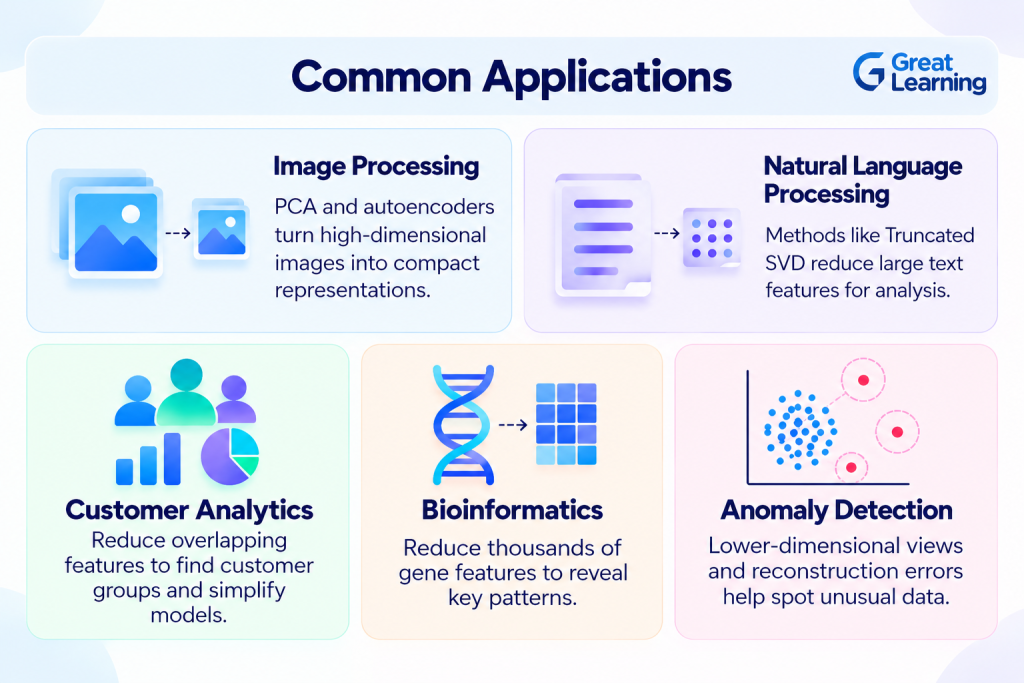
Image processing: Images can include 1000’s of pixel options. PCA and autoencoders can produce compact representations for evaluation or downstream modeling.
Natural language processing: Text knowledge represented by giant sparse matrices, equivalent to TF-IDF options, can profit from strategies equivalent to Truncated SVD. Dense textual content embeddings might also be diminished for visualization or specialised downstream duties.
Customer analytics: Reducing overlapping behavioral options can assist analysts discover buyer teams and simplify sure predictive fashions.
Bioinformatics: Gene expression datasets might include 1000’s of measurements throughout a comparatively small variety of samples. Reduction methods can assist reveal broad patterns, although validation is important as a result of biologically essential alerts could also be misplaced.
Anomaly detection: A lower-dimensional illustration might make uncommon observations simpler to determine. Reconstruction errors from strategies equivalent to autoencoders can even function anomaly alerts when correctly educated and calibrated.
Challenges to contemplate
Dimensionality discount includes trade-offs. PCA preserves instructions of excessive variance, however excessive variance doesn’t at all times correspond to predictive worth.
Nonlinear visualization methods might reveal native patterns whereas distorting world geometry.
Aggressive discount can discard helpful info, whereas retaining too many dimensions can undermine the supposed effectivity positive aspects.
Interpretability is one other consideration. A specific set of unique variables is commonly simpler to elucidate than a set of remodeled elements.
Best practices for selecting a technique
Start by defining the target. If the objective is quicker mannequin coaching, consider downstream efficiency and useful resource use.
If the objective is visualization, prioritize strategies designed to reveal helpful construction. If class separation issues, contemplate supervised strategies the place applicable.
Standardize numerical options when variations in scale would distort the chosen technique. Fit preprocessing and discount steps solely on coaching knowledge by inserting them inside a pipeline. Compare towards a baseline with out dimensionality discount, and use cross-validation to test whether or not outcomes generalize.
Finally, do not forget that the variety of retained elements is a modeling selection.
Explained variance can information PCA choice, however the last determination must also contemplate predictive efficiency, interpretability, computational value, and the necessities of the appliance.
Building experience in knowledge preprocessing, statistical evaluation, and machine studying can assist you’re employed extra successfully with complicated datasets. Explore the Data Science and Machine Learning course from MIT IDSS to develop sensible expertise in knowledge science, machine studying, and AI.
The central lesson is that dimensionality discount isn’t merely about making a dataset smaller. It is about discovering a helpful illustration of the info for a selected goal.
By matching the strategy to the issue and validating the outcomes, knowledge scientists could make high-dimensional datasets simpler to investigate and extra sensible to make use of in machine studying pipelines.
Frequently Asked Questions
1. What is dimensionality discount in machine studying?
Dimensionality discount reduces the variety of options in a dataset whereas retaining essential info. It can simplify evaluation, decrease computational prices, and assist visualization of complicated, high-dimensional knowledge and modeling.
2. What are the primary dimensionality discount methods?
Common methods embody PCA, SVD, LDA, t-SNE, UMAP, and autoencoders. Choose a technique based mostly on the dataset, goal, and whether or not prediction or visualization issues most at hand.
3. What is the distinction between PCA and t-SNE?
PCA captures maximum-variance instructions by a linear transformation. t-SNE is nonlinear and emphasizes native neighborhood patterns for visualization, however distances between separated clusters might not replicate unique knowledge geometry precisely.
4. Does dimensionality discount enhance mannequin efficiency?
Dimensionality discount can scale back computational prices and redundancy, generally enhancing generalization. However, it might discard predictive info, so evaluate fashions with and with out discount utilizing cross-validation on the identical dataset.
5. How is dimensionality discount carried out in Python?
In Python, scikit-learn offers PCA by sklearn.decomposition.PCA. Scale options when applicable, match preprocessing on coaching knowledge solely, remodel datasets, then consider the downstream mannequin utilizing appropriate metrics.
6. What is the distinction between characteristic choice and dimensionality discount?
Feature choice retains chosen unique variables. Feature extraction transforms current variables into new representations; PCA is characteristic extraction as a result of its elements mix unique options into fewer dimensions for downstream modeling.
7. When do you have to use dimensionality discount?
Use dimensionality discount when datasets have many options, redundant info, or expensive computations. It helps visualization and environment friendly modeling, however consider whether or not diminished options retain task-relevant info earlier than utilizing them.
