


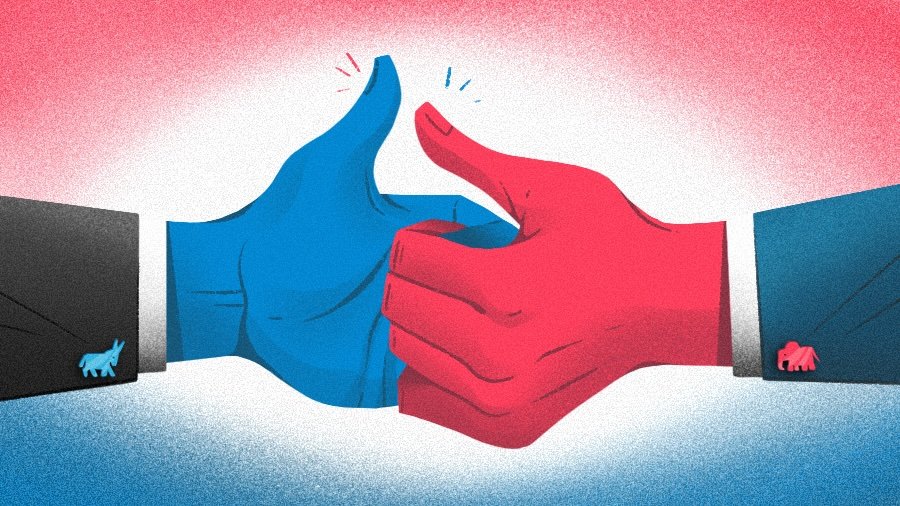
For the previous few a long time, the overwhelming majority of U.S. startup funding has persistently gone to firms in blue states or purple states, the place Democrats management all or some statewide places of work.
But with Tuesday’s election outcomes, the funding divide between blue, purple and crimson states has grown much more pronounced.
So far this yr, lower than 2% of all startup funding has gone to firms in post-election crimson states, outlined as these that may have each a Republican governor and two Republican U.S. senators.
The crimson states’ share is far smaller than in years’ previous resulting from 5 states shifting to purple. Of these, the most important enterprise hub is Texas, which shifted to purple with the election of Democratic Senator James Talarico and Governor Gina Hinojosa, adopted by Ohio.
This yr, as of Election Day, startups within the remaining 17 crimson states 1, that are house to almost 1 / 4 of Americans, had collectively pulled in simply $8.6 billion in enterprise funding, with Florida, Tennessee and Utah among the many largest contributors. To put that in perspective: It’s lower than the everyday nationwide whole in a single week.
Purple states rising
The 10 purple U.S. states2, in the meantime, are house to simply over 1 / 4 of Americans and pulled in about $28.6 billion this yr as of Election Day. That’s a lot increased than the crimson state tally, however nonetheless lower than 6% of all U.S. startup funding.
Beyond the aforementioned newcomers Texas and Ohio, a number of different purple states usually pull in sizable enterprise funding, together with Pennsylvania, North Carolina and to some extent Wisconsin.
Also value noting: The divide between crimson, purple and blue states is considerably much less stark in terms of spherical counts. About 12% of startup financings of $1 million or extra went to purple state firms this yr, and about 9% went to crimson states.
Broadly, it appears to be like like backers are nonetheless discovering loads of investment-worthy expertise outdoors of blue states in terms of smaller offers. However, they’re concentrating most of their capital into huge AI rounds for California and New York firms.
Blue states recover from 90% of startup funding
This brings us to our subsequent level: Blue states obtain the overwhelming majority of startup funding, of which most goes to California.3
Politics and what makes for a enterprise hub
So is it politics, or coincidence?
Broadly talking, the qualities that geographic startup hubs share — comparable to a deep tech expertise pool, city environs, main tech firms and prime analysis universities — aren’t particularly the area of blue states. That mentioned, predominantly rural states, which are likely to lean crimson, are much less more likely to have these substances.
Even so, there’s no rule in opposition to crimson state startup prowess. Austin, for instance, managed to cement its standing as a significant tech hub even whereas Texas remained solidly beneath Republican management. And Utah additionally boasts a complicated startup scene.
But following a Democratic electoral sweep, it’s hardly a shock that extra startup hubs now discover themselves situated in blue or purple states.
