


By Alberto Onetti
The “blue economy,” which encompasses industries constructed round oceans and coasts — from transport and fisheries to offshore power and marine biotechnology — is likely one of the largest, but least seen, engines of the worldwide economic system.
For startups, meaning alternatives to modernize how we transfer items, produce power and handle marine assets.
The blue economic system has doubled in dimension in only a quarter of a century, reaching $2.6 trillion in worth. To put this in perspective: If the blue economic system have been a rustic, it will be the world’s fifth largest. And because the world turns again to the ocean to face more and more important challenges, from geopolitical instability to rising power costs and local weather resilience, the blue economic system is about to turn into much more central.
Powerful “blue technology” forces of disruption are at play. Digitalization and automation, the power transition, environmental pressures and advances in marine biotechnology are all reshaping how worth is created at sea.

Blue tech: A sector defying world slowdown
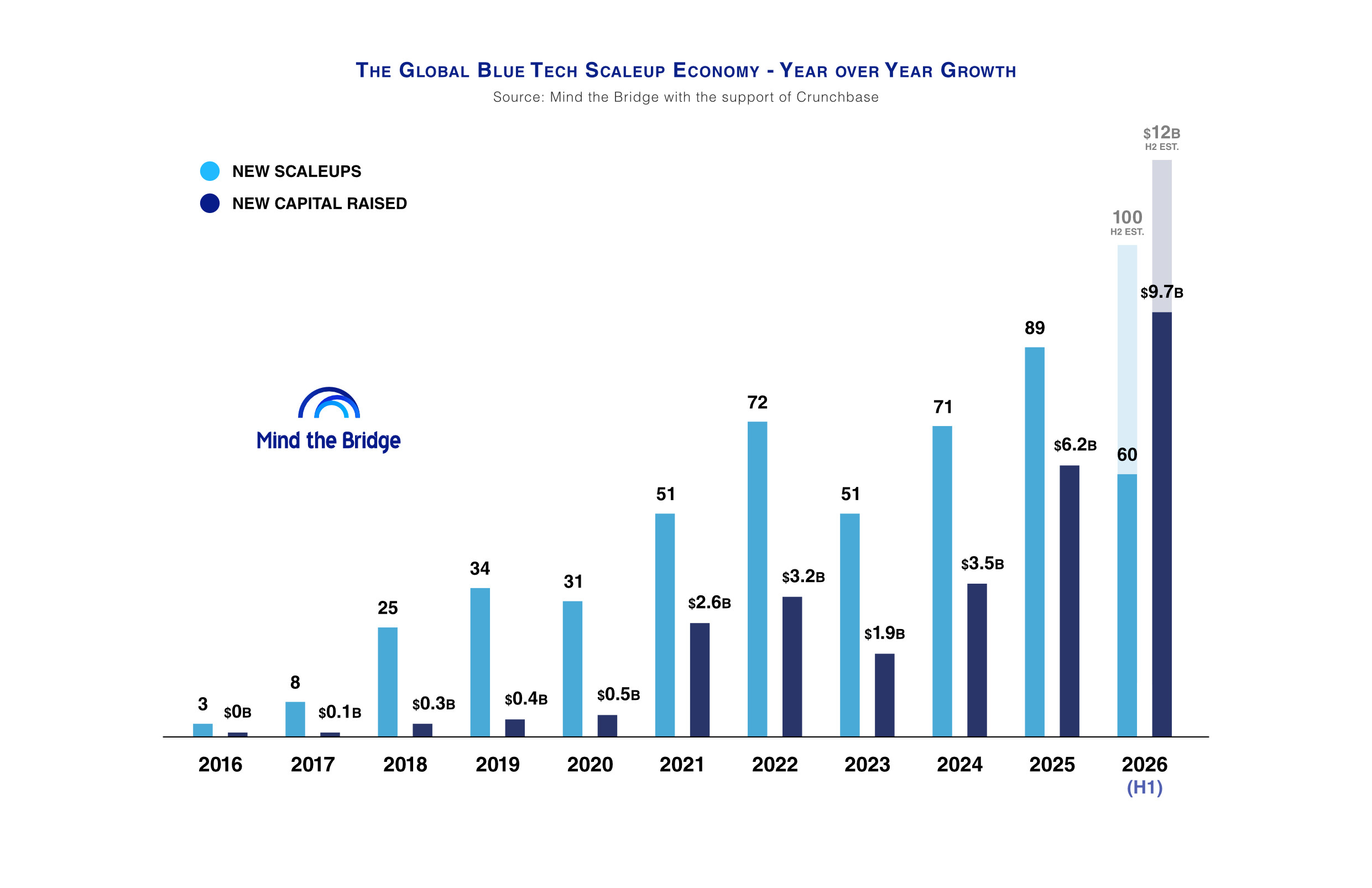
Against the prevailing development within the world innovation panorama, blue tech has adopted a considerably steady upward trajectory since 2021, producing a mean of 70 new scaleups per 12 months — much more quickly over the previous two years. Preliminary figures for 2026 counsel that roughly 100 new blue tech scaleups might emerge by year-end.
The drivers? Exceptional maritime resilience offers involving protection and infrastructure firms corresponding to Anduril Industries ($5 billion raised in 2026) and Helsing ($1.8 billion raised in 2026).
Not all blue tech is identical
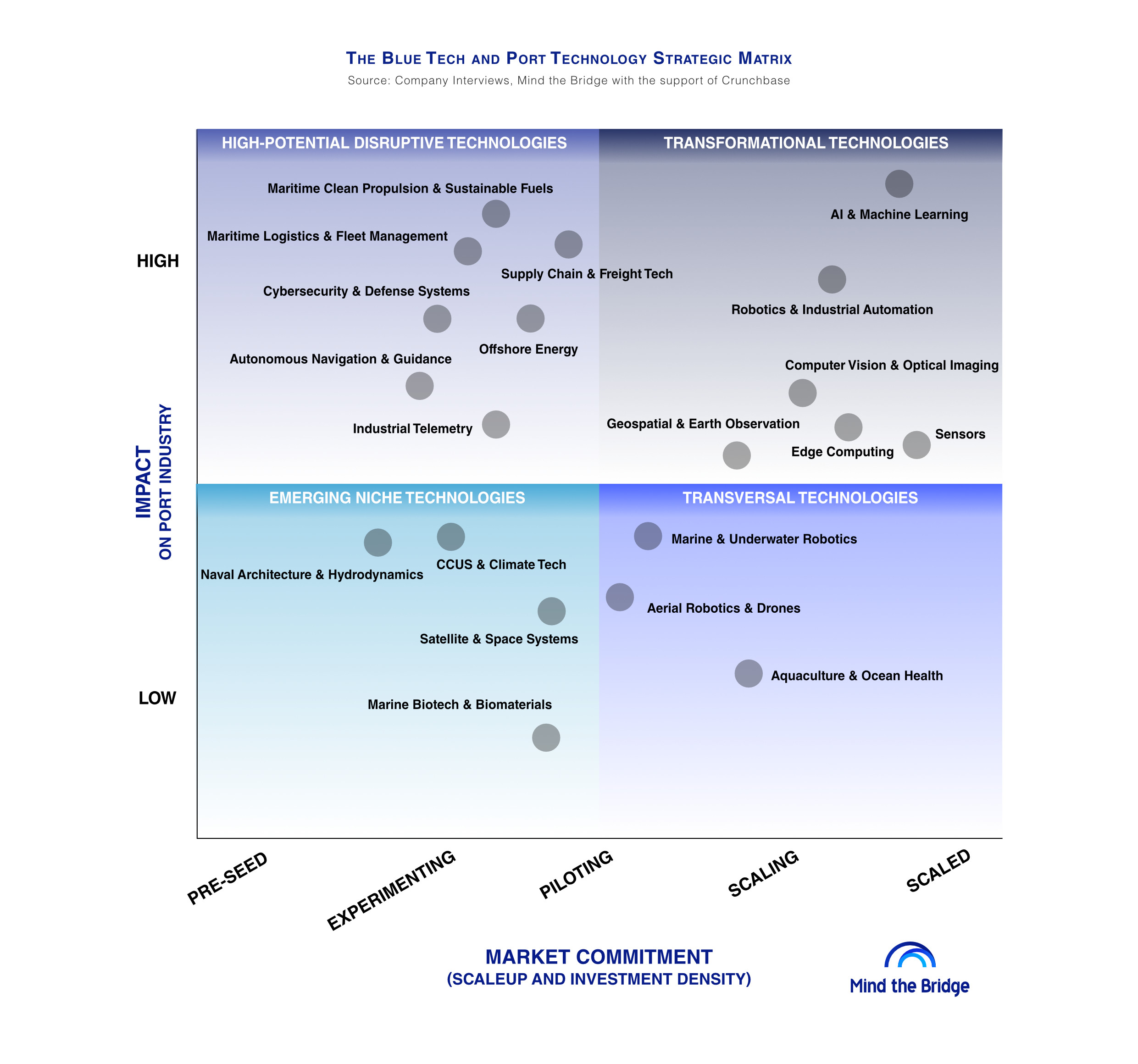
Blue tech is a broad class together with a various set of applied sciences, a few of that are extra mature than others. To make clear the sector’s composition, we clustered every distinctive know-how developed by blue tech scaleups into 20 teams.
We then assessed every group from two completely different views: affect on the trade and market dedication (a mix of scaleup and capital invested density).
The result’s a matrix highlighting:
- Transformational applied sciences which have a excessive affect and are comparatively well-established. Among these, AI and machine studying, and robotics and industrial automation occupies a specific candy spot of excessive affect, substantial funding and excessive scaleup density (greater than 200 scaleups and $20 billion invested in whole).
- High-potential disruptive applied sciences, with solely comparatively decrease ranges of funding and scaleup density (roughly 50 scaleups and $3 billion to $5 billion invested per cluster). Among them, essentially the most promising ones are maritime clear propulsion and sustainable fuels, and provide chain and freight tech.
The different quadrants are populated by transversal applied sciences with a extra oblique affect on the trade and rising area of interest applied sciences.
Ports: the ‘smartest smart cities’
The final query is: Who will experience the wave of change of the Blue Economy?
Short reply: ports.
And like sensible cities a decade in the past, they now want a playbook.
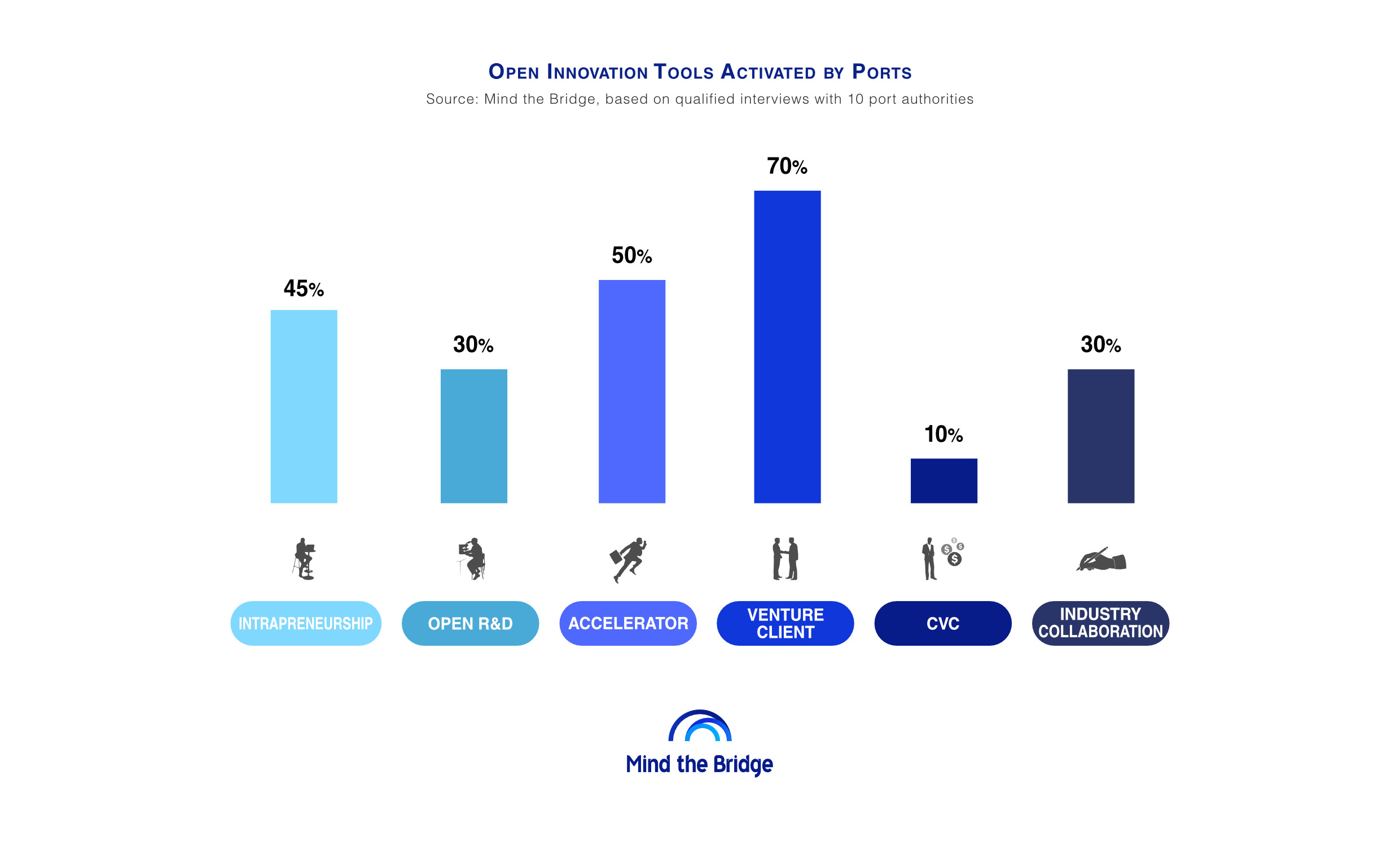
To present a complete perspective from the ports’ standpoint, in our report we interviewed 10 of the world’s main port authorities to grasp their priorities, challenges and limitations to innovation.
While doing so, we collected a number of case research from authorities such because the ports of Barcelona, Bergen, Seattle, Rotterdam and Los Angeles — true blueprints of greatest practices in tackling the innovation challenges of the blue economic system.
The result’s an image that exhibits the potential of blue tech because the catalyst for a radical evolution of one of many largest sectors of the worldwide economic system.
Yet, to actually “get there” port authorities, operators, startups, traders and policymakers want a shared agenda and imaginative and prescient, engaged on the identical challenges.
Notice to (innovation) sailors: the course of blue economic system innovation is about. The problem now’s to catch the favorable winds — and experience them.
Get the total story in Mind The Bridge’s report, out there without cost obtain right here.
Alberto Onetti is chairman of Mind the Bridge and a professor at University of Insubria. He is a serial entrepreneur who has began three startups in his profession, the final of which is Funambol, among the many 5 Italian scaleups which have raised the biggest quantity of capital. He is acknowledged among the many main worldwide specialists in open innovation and has broad expertise in organising and managing open innovation initiatives — enterprise shoppers, enterprise builders, intrapreneurship, CVCs — with massive multinational firms, in addition to advising and coaching on this topic. Onetti has a column on Sifted (Financial Times) and a number of other different tech blogs.